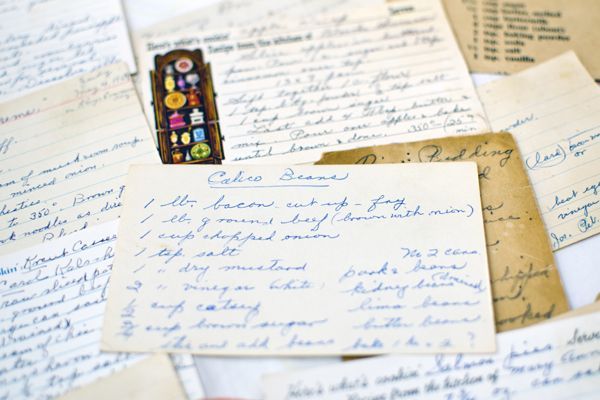
Make your own family recipe book

What does it mean to leave a legacy? When people we love pass away, they leave us with memories, but they often leave us with tangible gifts, too. Those may come in the form of family photo albums, letters, or journals. If we’re lucky, they leave behind important traditions that stick with our families for generations.

Food has a way of bringing people together … during times of great happiness, celebration, or even sadness. On the landmark days in our lives – the ones that stick strongly in our memories – we can often recall the meals we shared and who we shared them with. And many of us can remember the special dishes our parents or grandparents prepared for us. In my family, it was Grandma’s bread rolls that signified togetherness and warmth. We could smell them baking on Christmas morning, and we’d slather them with butter and strawberry jam before opening presents. My first memory in the kitchen was standing on a stool at Grandma’s side, watching as she pulled perfectly uniform balls of dough through her fingers, and attempting to copy her technique with my own untrained hands. Still, today, long since my grandmother has passed away, baking bread is my small way of filling my home with comfort and love. I look to her techniques as I learn new recipes and try to perfect old ones. Always, when I bake bread, I think about her, and I imagine myself as a child, standing on a stool and breathing in the importance of that moment.

The history of recipes in my family contributes to occasions big and small. When we make the same oatmeal cookie recipe we’ve been making forever, we talk about how I prefer them with only chocolate chips, Mom and Dad prefer them with chocolate chips and raisins, and my aunt prefers only raisins. (She once told us she doesn’t like that she can’t tell, by sight, the difference between the raisins and the chocolate chips.) When we make spaghetti sauce (an old “recipe” which includes almost no exact measurements), we talk about how different members of our family have adapted the sugar content over the years. New traditions have formed over time, as well – traditions that I’ll pass down to my children someday. Our favorite gingerbread cookie recipe is reserved for the day after Thanksgiving. Our meatless barbecue sandwich recipe is best served on football game days. And individual homemade pizzas are the perfect activity for bringing a new boyfriend or girlfriend home for the first time.

The importance of recording and remembering these recipes can be enormous in creating a lasting legacy for the people we love. Now, at the beginning of a time of year when food is at the center of practically all we do, we recommend starting to collect and share your family’s most important food memories. This can be an easy or difficult task, depending upon the records that already exist within your family. In mine, we were lucky that most of our favorite recipes had already been recorded. Some of them, like the spaghetti sauce, were rather vague, and we’ve worked together to determine measurements on our own. All we needed to do was make a detailed list, organize the recipes, and compile them. My mom made my siblings and me the most incredible Christmas gift when she pulled all of our family recipes into a single-bound book with space for future additions. In other families, the best chefs among you may not keep detailed notes about the dishes they make. In these cases, your interviewing skills will become most useful. Ask your family member if he or she would be willing to attempt to record a detailed recipe for you, or even watch the next time they make the dish and record the recipe yourself. It might take some work, but chances are the results will be worth the effort for you and your family.

If you’re collecting recipes into a book as my mom did, you can find resources for getting started at the following links. These make wonderful gifts that will be treasured for years to come.

  • Making a cookbook using Microsoft Word – This Instructables tutorial walks you through how to format and organize a recipe book without special software.
  • How to update old recipes – Older recipes sometimes contain ingredients or processes that are rarely used in modern kitchens. This blog post contains some great tips for using old recipes today.

We recommend also saving a digital version of your collection in case the hard copies are lost or destroyed. (Any regular cook has spilled sauce on or burned the pages of at least one recipe book in the past.) My mom turned each recipe into a file that was uploaded to an online sharing space. Now everybody in my family can access all of our recipes even when we're not at home.

Finally, while there’s certainly something to be said for updating old recipes to make them novice-friendly, there’s also something to be said for paying homage to the originals: the old stained notecards on which Grandma’s beautiful penmanship lists all ingredients in “pinches” and “scoops.” Scanning and digitizing these mementos in the same way you would old photos and printing or saving them will ensure that the character that accompanied the recipe isn’t lost forever.

By duda September 10, 2026
A practical, step-by-step guide walking families through what to do immediately after a death, from the first hours through funeral planning and the estate tasks that follow.
September 3, 2026
When you are considering cremation for your own future plans or those of a loved one, it is important to understand the safeguards that our funeral home has in place to maintain the integrity of the cremation process. A detailed and well-documented process means that families can be assured that the cremated remains returned to them are those of their loved one. At our funeral home, we have a high standard of professional ethics and detailed procedures regarding the cremation process. We have our own on-site crematory, so your loved one will never leave our care. Multiple steps are taken to maintain an individual’s personal identity throughout the process. An identification band is placed on them the moment they are brought into our care. A funeral director and members of the family will review all cremation paperwork prior to cremation. Families have the option to view their loved one before cremation takes place for a final goodbye. When the time comes for cremation, a numbered stainless steel identification tag will be placed with the deceased which stays with them through the cremation process. This information will be entered into our funeral home’s permanent record. Family members have the option to witness the beginning of cremation, or stay for the duration of the process, if desired. After cremation is complete, the stainless steel identification tag will stay with the cremated remains, which will be placed in the urn or container that the family has selected. When it is time to return the remains to the family, we will confirm that the person receiving the remains is authorized to do so, and photocopy their photo ID to further ensure the integrity of the process. With these safeguards in place, you can have confidence that if you choose our funeral home, your loved one will be cared for with dignity and respect, and their personal identity is maintained every step of the way. If you have any questions, please do not hesitate to reach out to us. We are here to help.
By Funeral Home July 23, 2026
A practical checklist of essential end-of-life legal, financial, and final wishes documents every family should organize to bring peace of mind.
June 22, 2026
What are the first steps when a loved one passes away? The first step is to notify the proper authorities. If your loved one passes at home, you’ll need to contact emergency services. If the passing occurs in a hospital or care facility, staff will guide you through the next steps. Once this has been done, you can contact a funeral home. Our team is available to help you begin arrangements and coordinate transportation of your loved one into our care. Do I need to plan the funeral right away? While some decisions need to be made relatively quickly, you do not have to finalize every detail immediately. We will help you prioritize what needs to be handled first and give you time to consider the more personal elements of the service. What types of funeral services are available? There are several options available depending on your preferences, beliefs, and budget. These may include: Traditional funeral services with a viewing and burial Memorial services (held after burial or cremation) Graveside services Celebration of life Cremation services with or without a formal ceremony We are here to help you create a meaningful service that reflects your loved one’s life. How much does a funeral cost? Funeral costs can vary widely depending on the services and options selected. Factors that may influence cost include: Burial or cremation choice Casket or urn selection Venue and staffing Transportation Printed materials and flowers We are committed to transparency and will walk you through all options to help you make decisions that align with your needs and budget. Can I personalize the service? Absolutely. Personalization is one of the most meaningful parts of a funeral service. Families often include: Favorite music or readings Photo displays or memory tables Video tributes Special themes or colors Cultural or religious traditions Our goal is to help you create a service that truly reflects your loved one’s personality and legacy. What should I bring to the arrangement meeting? It’s helpful to bring: A recent photo of your loved one Clothing for burial or cremation Personal information (full name, date of birth, Social Security number, etc.) Military discharge papers (if applicable) Preplanning documents (if arrangements were made in advance) Don’t worry if you don’t have everything—we can guide you through what’s needed. What is preplanning and is it necessary? Preplanning allows individuals to make their own funeral arrangements in advance. While it is not required, it can ease the burden on loved ones and ensure that personal wishes are honored. Many families find comfort in knowing these decisions have already been made. What happens after the service? After the service, we continue to support families by: Assisting with necessary paperwork Providing grief resources Helping coordinate burial or cremation follow-up Offering guidance on memorialization options Our care does not end after the service—we are here for you in the days and months that follow. We’re Here to Help Planning a funeral is never easy, but you don’t have to do it alone. Our compassionate team is here to answer your questions, guide you through each step, and help you create a meaningful tribute for your loved one. If you have additional questions or would like to begin planning, please don’t hesitate to reach out.
More Posts »

More Resources & Support